Gilmore Girls and the "Magic Risotto:" the negative cognitive bias
- Rachel Jeong
- Jul 18, 2024
- 3 min read

PSYCHOLOGY
Song feature: "Linger," by The Cranberries
Written by Rachel Jeong
If you’ve ever seen Gilmore Girls, you’d know of Sookie St. James’s famous “magic risotto.” You’d also know that this is the very food that brought her mother back to life from her deathbed. So obviously, upon a negative food review from a renowned food critic, you’d expect Sookie would be quite offended.
Except it wasn’t a negative review.
In fact, critic Lucien Mills lauded her simple garden salad and her creamy lobster bisque. He used the words “divine, delirious, and delectable” to describe the Independence Inn dining experience. So what was the problem?
“The risotto was fine.”
Out of all her positive reviews, the only thing Sookie could focus on and remember for weeks was the “...was fine.” This is an example of negative cognitive bias.
Negative cognitive bias
According to psychology business Positive Psychology, negative cognitive bias is a biological tendency to relatively fixate on the negatives, often outweighing the neutral or positive aspects of a situation. Specifically, there is a negative attention bias and negative memory bias. Army Medical University’s School of Psychology’s Kuan Miao et. al describe these biases in their negative cognitive bias processing scale research:
“Negative attention bias, which acts as the first filter for information selection, shows an attentional preference for negative stimuli and deviation from positive stimuli (13). Negative memory bias is the inclination to recall negative materials more often than positive materials.”
Not only did Sookie filter through all the positive praise as if it were a given, but she held an innate gravitation towards the negative reviews.
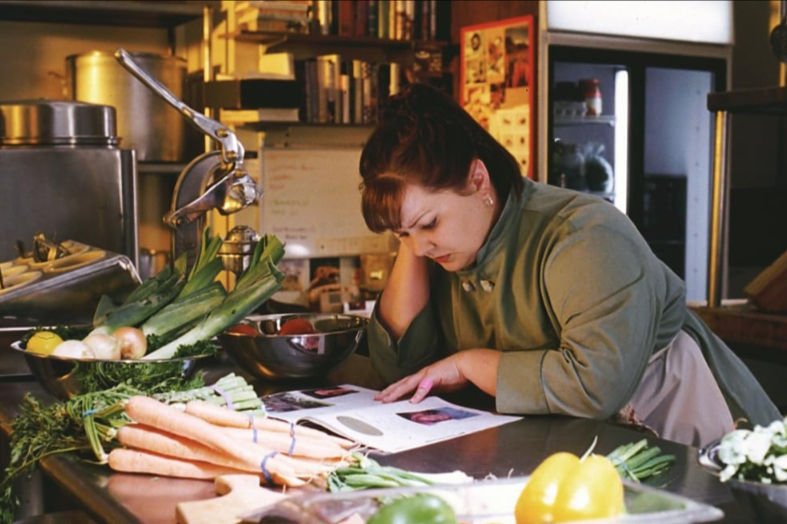
Sookie St. James is seen moping at her desk, chin sinking on cupped palm, enthusiasm annoyed and deflated out of her: she seems to only remember the “negative” critique, and lingers only on that.
This creates a distortion in both Sookie’s memory, and her scale of perspective on her cooking’s successes and detractions. Plus, the more we recall or linger on a certain memory, the more we distort it. And in Sookie’s case, it only snowballs starting from a poignant
“misinterpretation of…information in a more negative way (1)”
Cognitive biases
According to a 2023 study published in frontiers in Psychology,
“Cognitive biases can be generally described as systematic, universally occurring, tendencies, inclinations, or dispositions in human decision making that may make it vulnerable for inaccurate, suboptimal, or wrong outcomes (e.g., Tversky and Kahneman, 1974; Kahneman, 2011; Korteling and Toet, 2022).
Well-known examples of biases are hindsight bias (once we know the outcome, we tend to think we knew that all along), tunnel vision (when we are under pressure, we tend to overfocus on our goal and ignore all other things that are happening), and confirmation bias (we tend to only see information that confirms our existing ideas and expectations). People typically tend to pursue self-interest at the expense of the community (Tragedy of the commons). We tend to over-value items we possess (Endowment effect) and we have a strong urge to persist in courses of action, with negative outcomes (Sunk-cost fallacy). What is more, biased decision making feels quite natural and self-evident, such that we are quite blind to our own biases (Pronin et al., 2002).”
This means we often aren’t cognizant of our distortion, and therefore don’t realize the extent of biases’ influence in our decision making. It is important to recognize our own biases in understanding things, especially when the situation at hand requires a full, proportional understanding of what is real.
It is absolutely fascinating to realize and examine how much distortion happens in the process of delivery, reception, and processing of information in our brains. What’s scarier (or cooler), is that most of us live most of our lives in our heads, instead of in the world. There are so many different realities being lived now. Who knows if there is one cosmic truth under that.
However, all of these relatively distorted realities eventually come together to create the supposition that this experience is all part of being human. Nevertheless, without wanting to gaslight or invalidate poor Sookie’s intellectualism, we end with Word for Thought’s catchphrase--it really is all in your head.
Harboring angry feelings towards Lucien Mills? Redeem Sookie by checking out this recipe on how to make her magic risotto yourself.
IMG Credits: IMDb "Deer Hunters"


Comments